
Product strategy
What to validate before committing to a product redesign
A redesign is a delivery decision, not a diagnosis. Before changing the interface, a team needs enough evidence to explain what is failing, for whom, and what a better outcome would look like.
Teams often arrive at a redesign after accumulating interface complaints, stakeholder requests, and technical debt. Those signals matter, but they do not yet define the problem. A short product discovery phase separates symptoms from causes and makes the investment easier to defend.
Start with the decision the redesign must support
The useful starting question is not “What should the new interface look like?” It is “What must become easier, clearer, or more valuable after this work?” That change might concern activation, task completion, conversion, support demand, or delivery speed.
The minimum evidence set
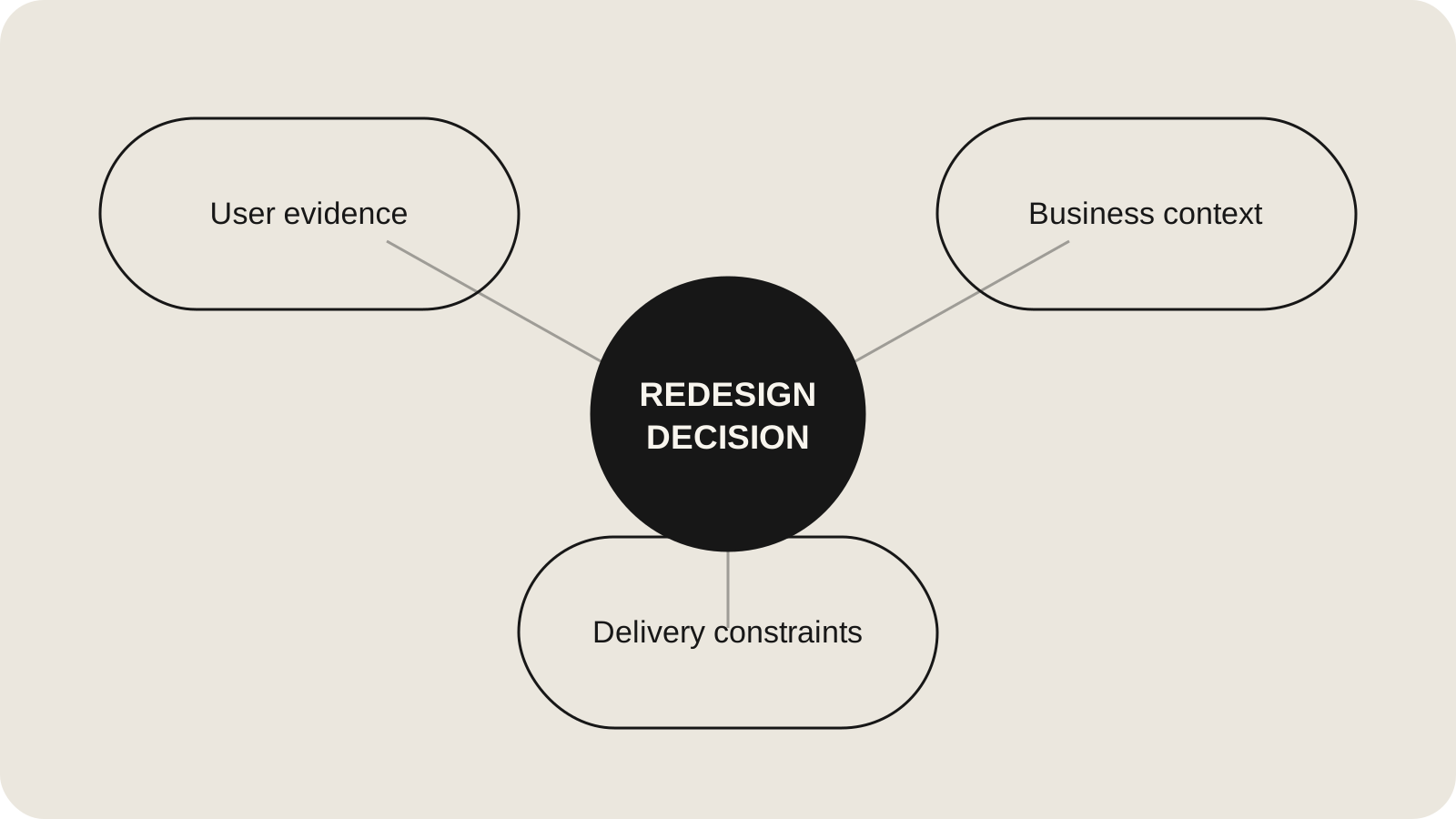
- A clear view of the priority audience and the task they are trying to complete.
- Behavioral evidence from analytics, support, sales, research, or usability testing.
- Known business, technical, content, legal, and operational constraints.
- A baseline measure that can be compared with the redesigned experience.
Questions to answer before scoping
| Area | Question | Useful evidence |
|---|---|---|
| Problem | What is not working today? | Research, support themes, funnel behavior |
| Audience | Whose outcome matters most? | Segments, jobs, account value, context |
| Constraint | What cannot be ignored? | Technology, content, regulation, operations |
| Success | What should improve? | Baseline metric and qualitative signal |
A responsible sequence
- Frame the decision and agree on the primary outcome.
- Collect only the evidence required to reduce the largest risks.
- Model and test the critical journey before designing the complete system.
- Define scope, measurement, and delivery responsibilities together.
The goal of discovery is not to delay delivery. It is to prevent the team from delivering the wrong certainty.
Synergize product principle
Turn evidence into a scoped next step
The result does not always need to be a complete redesign. The evidence may support a focused journey improvement, a content and information architecture change, a technical rebuild, or a staged product program. The right scope follows the problem—not the other way around.
FAQ
Questions teams ask.
How much research is needed before a redesign?
Enough to explain the priority problem, the affected audience, the riskiest assumptions, and the baseline outcome. For a focused journey this may take days; a complex product may need a deeper discovery engagement.
Can design begin before all evidence is available?
Yes. Early prototypes can be part of the research. The important distinction is that they are used to learn before the team commits to a complete solution.
What should a redesign brief contain?
It should state the problem, audience, desired outcome, evidence, constraints, priority journeys, success measures, responsibilities, and known exclusions.